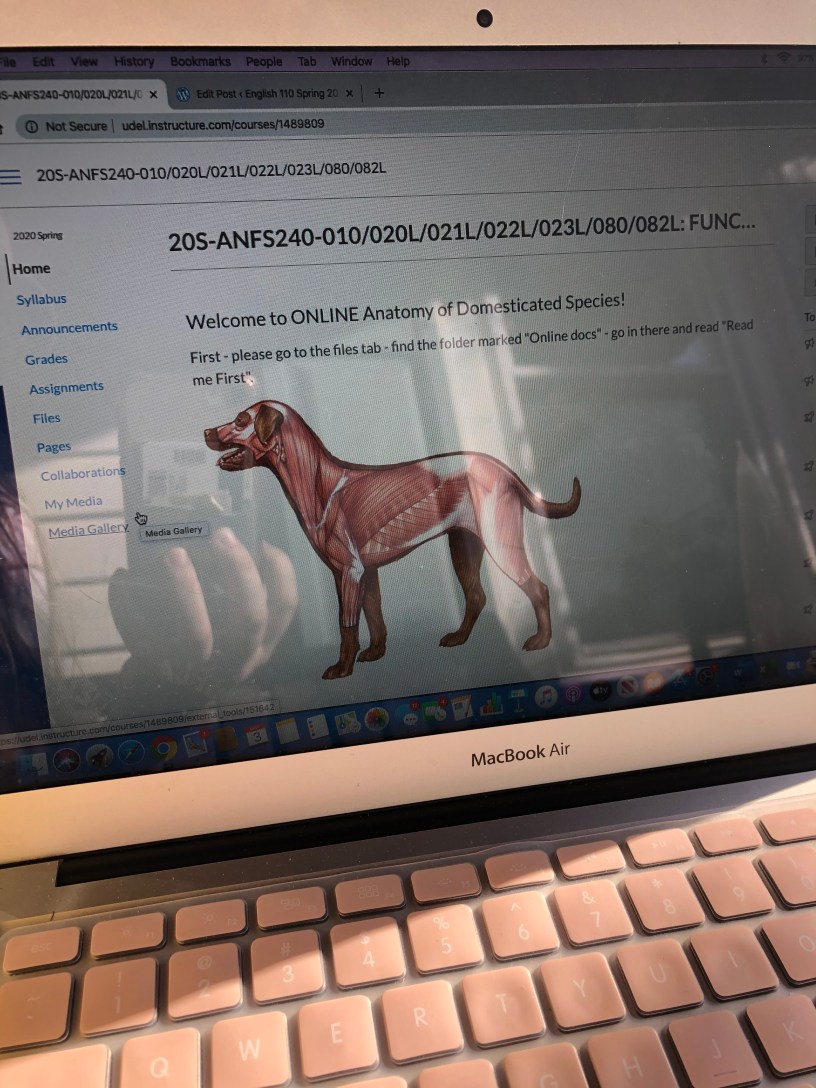
The Covid-19 pandemic has drastically changed the lives of every person across the planet, and as students attending a University in the United States, the change in our education has been a topic that directly affects us. Being a student at the University of Delaware went from a learning experience of in-person lectures, weekly trips to the library and favorite studying spaces, study groups, interactive education, and more. It was a time period of being enriched with knowledge, new experiences, and new people in ways most of us have never had before. Now, we, along with students from other universities, high schools, middle schools, and elementary schools are confined to learning from a computer screen in our bedrooms. It has been a sudden change and adjustment that I have never expected, and unfortunately this new way of learning will not return to the old for some time to come.
It is safe to say that the quality of most of our classes has dropped, as online zooms and tests are just not equivalent to the more face-to-face education we were previously receiving. Not only are we not learning as effectively as we could, but college is not cheap. With the disappointing realization that our lives are not going back to normal anytime soon, the growing concern for college students across the country is this large group of people “…are still paying big prices for an online education product that typically costs less, that researchers believe is less effective and that students and professors find less valuable” (Hess, 2020). It is a reasonable concern for those paying so much for the new online education, and I personally know people who are considering attending or transferring to community colleges during this time, or even taking a gap year from high school to their freshman year of college.
Teachers and professors of all grade levels must also prepare to continue this way of teaching for upcoming semesters and school years. This is not an easy time for anyone, and it can also be difficult on our educators, as zoom sessions can be easily interrupted, skipped, or lack the attention of students; of course, this does not include most students, many of whom are paying the absurd college expenses. In a Forbes article written by a college professor, wrote, “Our relationship is based on trust: they want to be taught as productively as possible in the best possible way under the present circumstances, and I want to do the same, teach the the best way possible under the current circumstances” (Dans, 2020). Family friends of mine who work with students who may have learning disabilities or require more attention are working extra hours every day, zooming one-on-one with the students to make sure they are able to still keep up when learning is even more difficult.
Another big concern in the change to more online education moving forward with the pandemic, is the large gap it is creating for students who do not have the access to quality technology or internet connection. This is a big issue in rural communities, lower income communities, and impoverished countries. It is affecting students of every age, and it is a situation that should be addressed moving forward. Authors Gloria Tam and Diana El-Azar of a the article “3 Ways the Coronavirus Pandemic could Reshape Education” write, “…the less affluent and digitally savvy individual families are, the further their students are left behind. When classes transition online, these children lose out because of the cost of digital devices and data plans.” The more alarming part of this is that lower-quality education in these areas is not new. In fact, “Most education systems in low- and middle-income countries were grossly underfinanced even before the coronavirus crisis”(Thomas, 2020).
Among the many changes caused by this pandemic, the education system is one that will most likely remain different than the norm moving forward, as schools will need to be very cautious in having students return to campuses and classrooms.
Works Cited
Dans, Enrique. “How Coronavirus Is Going To Change Education Forever.” Forbes, Forbes Magazine, 27 Mar. 2020, http://www.forbes.com/sites/enriquedans/2020/03/24/how-coronavirus-is-going-to-change-education-forever/#774be97e4dfe.
Hess, Abigail J. “How Coronavirus Dramatically Changed College for over 14 Million Students.” CNBC, CNBC, 26 Mar. 2020, http://www.cnbc.com/2020/03/26/how-coronavirus-changed-college-for-over-14-million-students.html
Tam, Gloria, et al. “3 Ways the Coronavirus Pandemic Could Reshape Education.” World Economic Forum, 13 Mar. 2020, http://www.weforum.org/agenda/2020/03/3-ways-coronavirus-is-reshaping-education-and-what-changes-might-be-here-to-stay/.
Thomas, Christopher J. “Coronavirus and Challenging Times for Education in Developing Countries.” Brookings, Brookings, 14 Apr. 2020, http://www.brookings.edu/blog/education-plus-development/2020/04/13/coronavirus-and-challenging-times-for-education-in-developing-countries/.
 English 110 Spring 2020 10:10-11:00
Elizabeth,
I related to this post and enjoyed reading it. I like that you focused on the education system, all forms of it. One of my family members is a special-education teacher, and she has mentioned how difficult teaching new material on Zoom is. College is crazy overpriced, and I do feel online classes have been less effective. If colleges keep their high tuition, I do believe more people will take a gap year or transfer. I know my family is deciding what I should do for next semester. It is a crazy time, but I don’t want to spend so much money on something that doesn’t give me the education I need. Great job on this assignment! I hope you and your family are healthy and doing well!
-Molly Corrigan
LikeLiked by 1 person
Elizabeth, this piece is extremely relatable. We are all struggling with our online classes, and still have two weeks of classes PLUS finals week. I think the education system is something COVID-19 has affected the most. My best friend is a senior in high school and she doesn’t get to have her senior track season, senior prom, or even a graduation. It is not only taking our learning away from us, but it is taking away life long memories we waited our whole life to make. I really enjoyed reading this piece!
-Grace
LikeLiked by 1 person
Tess this piece is so straight to the point and extremely relatable. I live out in the boondocks of Maryland and our internet has been crap to say the least–I’ve had to miss zoom calls someone in my family needed strong internet for something more important. My mother is a fourth-grade teacher at an inner-city school and she has little to no luck getting at least half of her students on zoom each day. She has become increasingly worried about her class being able to move forward onto fifth grade if they have not been present to learn. Your piece was thought-provoking and I really enjoyed the conversation it held! I hope all is well with you for the rest of your classes!
–Hannah Kirby
LikeLiked by 1 person
I am so sorry, Elizabeth, I had just read Tess’s piece and got names mixed up.
LikeLiked by 1 person
This was a great piece. I’m glad someone wrote about education, because for most people in our age group this aspect of our lives is definitely the most challenging. It’s difficult because the world seemed to stop but time doesn’t. Even though we had to shift our whole lives around and we cannot be at school anymore, we still must continue studying so that we don’t fall behind for when things do go back to normal. However, it’s beyond strange to complete school work while missing our on every other aspect of college, and also not getting the same grade of education, not because of the professor’s instruction, but just because we are lacking all interpersonal interaction. We are missing experiences we will never get back, but we must keep moving forward. Online learning is also tricky, because as the one professor in your article said, the relationship is built on trust. You are going to have the kids who cheat on everything and don’t actually go to class, the kids who spend all their hours doing the work, but grades are struggling because teaching isn’t the same, the kids who don’t have access to resources, and everything in between. My sister is also a junior in high school, and is stressing because she won’t be able to take her SAT for a couple months and doesn’t want it to affect her college applications. Her AP tests are also a much more condensed version, open note, and they only cover the material the class got to while at school. You’re going to have a very skewed group of results and also some kids getting credit for a college class that they didn’t actually learn all the material for. All in all, it’s a weird time, and I’m not sure what exactly education will look like after all of this, but I’m curious to find out.
Great work! I hope you’re doing well.
Emma Charles
LikeLiked by 1 person
After reading this, I realized it already have 5 comments and contemplated commenting on this because we are supposed to comment on other posts. However, I really related to this piece and loved how you focused on education alone. When you mentioned your family friends who work with disabilities are putting in extra time, that really caught my eye. I can see it from the other end because my brother is in a special needs program, and i’ve seen how the teachers efforts have impacted him as a student and individual. For many people with autism, a routine is really important and necessary to keep cognitive function high and keep them focused on their daily tasks. Now that my brother isn’t in school, his daily routine of walking to the bus stop at 7:27 AM and going about his daily schedule is completely gone. Socialization is also extremely important because he doesn’t have the same social skills as everyone else. Yet, he can’t go out and socialize with anyone due to the pandemic. Your family friends who work with disabled children sound incredible, but unfortunately it’s not the same in my brothers situation. His speech therapist is basically copying and pasting google images on a google doc, sending them to my mom for my brother to read out loud to her with simple words like “orange” or “house.” There are no zoom sessions, or any extra help, leaving my mom to have to make up all the classes for him. His occupational therapist in school sends simple exercises on a PDF file, leaving my mom and I trying to figure out wtf she’s implying he does. He was zoom sessions M,W,F with his class, but the online assignments that are supposed to be done before the class are extremely complicated to
complete. Text boxes need to be added and his work has to be put on the PDF file, which I couldn’t even figure out how to do. This whole situation has left my mom and I trying to teach him and do OT with him, on top of the work we have. I really appreciated this piece because I think it highlights a lot of underlying problems that people don’t see. Loved this piece! Hope you’re doing well !
– Colleen Dwyer
LikeLiked by 1 person
Hey Elizabeth!! I saw your piece had a lot of comments so I wanted to see what your piece was about and after reading it I couldn’t help but add to the comment sections. There has been a lot of talk about whether we will be returning to campus in the fall. All I can tell myself is to hope for the best but be ready for the worst. I know Online learning of course is not ideal and adds to the stress of the pandemic itself but there is truly nothing we can currently do to change it. I really related to the part where you mentioned your family friend who works with children with learning disabilities because my sister does as well. Everyday she worries about her students because she knows how sometimes the children she works with specifically (they not only have learning disabilities but behavioral disabilities as well) can be a-lot to handle and can get aggressive. A lot of times parents use the time the children are at school to either go to work or catch somewhat of a break for lack of a better term. She worries how the parents are holding up working from home and caring for children who require special care. Her school is closed and she cannot wait for it to open back up not only to see the children but to alleviate some of the stress the parents have. Overall your piece was very strong and brought to light many important arguments about he future. Hope all is well and everyone is safe and healthy. (Eleni LeClair)
LikeLike